

How can you ensure that PassGuideOp1 and PassGuideOp2 runs within the same transaction whenever they are calle
DRAG DROP
Service implementation exhibit:
class PassGuideService: IPassGuideService
{
public void PassGuideOp1(string value) {}
public void PassGuideOp2(string value) { }
}
Contract exhibit:
[ServiceContract(SessionMode s SessionMode Required)]
public interface IPassGuideService
{
[OperationContract(IsOneWay = true, IsInitiating = true)]
void PassGuideOp1(string value);
[OperationContract(IsOneWay = true, IsInitiating = false)]
void PassGuideOp2(string value);
}
There is a WCF (Windows Communication Foundation) service PassGuideService.
The contract and implementation of PassGuideService is being displayed in the exhibits.
NetMsmqBinding us used by PassGuideService to listen for messages.
The queue is configured to use transactions for removing and adding messages.
How can you ensure that PassGuideOp1 and PassGuideOp2 runs within the same transaction
whenever they are called within the same session?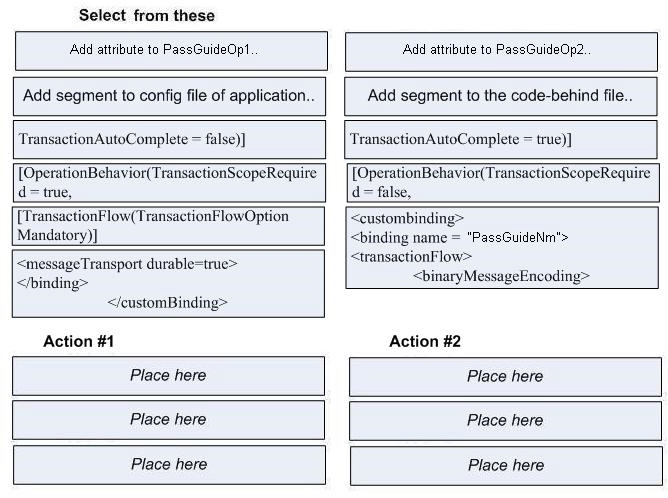
How can this be remedied?
DRAG DROP
ContractExhibit:
Interface
[ServiceContract]
public interface IPassGuideService
{
[OperationContract]
void SaveEmployee(Employee person);
}
Binding exhibit:
NetTcpBinding binding new NetTcpBinding { TransactionFlow = true };
Client Call exhibit:
using (TransactionScope ts = new TransactionScope(TransactionScopeOption.Required))
{ IPassGuideService client = factoryCreateChannel();
client SaveEmployee(employee);
ConsoleWriteLine(
TransactionCurrentTransactionlnformation.
DistributedIdentifier);
tsComplete();
}
SaveEmployee Exhibit:
public void IPassGuideService SaveEmployee(Employee employee)
{ employee.Save();
ConsoleWriteLine(TransactionCurrentTransactionlnformation.
Distributedidentifier);
}
There is a WCF (Windows Communication Foundation) service PassGuideService.
The service and the client has the service contract displayed in the contract exhibit.
The binding of the service and the client is displayed in the binding exhibit.
The client call exhibit displays how the client calls PassGuideService.
The implementation of the PassGuideService SaveEmployee method is displayed in the
SaveEmployee Exhibit.
However, there is a problem. There is distributed identifier mismatch between the client and
PassGuideService.
How can this be remedied?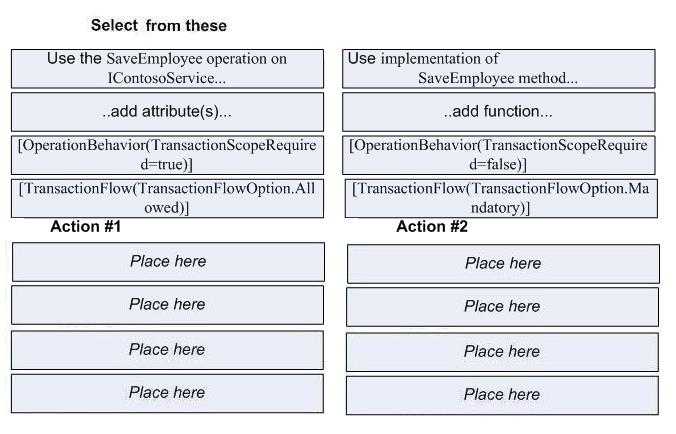
Which contract should be used?
DRAG DROP
There is a WCF (Windows Communication Foundation) solution for PassGuide.
You need to specify the contract complying to the following requirements:
PassGuideInitialize can always be called before PassGuideTerminate is called.
PassGuideSomething can only be called after PassGuideInitialize has been called.
PassGuideSomething cannot be called after PassGuideTerminate has been called.
PassGuideTerminate can only be called after PassGuideInitialize has been called.
Which contract should be used?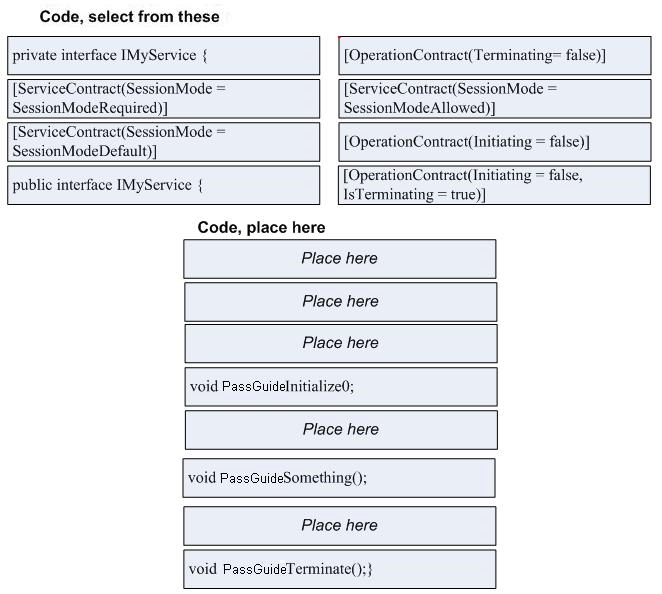
How can this be achieved?
DRAG DROP
There is a WCF (Windows Communication Foundation) service IPassGuideService in class
PassGuideService.
PassGuideService intermittently throws an exception and then fails.
Now you need to handle the unhandled exceptions to clients by sending the stack trace of these to
the clients as a fault message.
How can this be achieved?
How should this be achieved?
DRAG DROP
Soap envelope exhibit:
<s:Envelope xmlns:se’http://schemas.xmlsoporg/soap/enveloper’>
<s: Header>
<h:PassGuideID xmlns = “http:/www.PassGuide.com”>
9283
</h: PassGuideID>
</s:Header>
<s:Body>
<PassGuideStock xmlns=http://www.PassGuide.com”>
<ParticularID>1234 </ ParticularID >
</PassGuideStock>
</s: Body>
</s: Envelope>
The SOAP envelope in the exhibit must be generated.
How should this be achieved?
Which code should you use?
DRAG DROP
PassGuideService exhibit:
[OperationContract]
void PassGuideService(Order data);
There is a client PassGuideClient.
PassGuideClient sends multiple SOAP message to a WCF (Windows Communication Foundation)
service method PassGuideService.
PassGuideService must be tweaked so that any SOAP message can be received.
Which code should you use?
How can this be achieved?
DRAG DROP
PassGuideService Exhibit:
[ServiceContract]
public interface PassGuideService
{
[OperationContract]
DateTime GetPassGuideServiceTime;
}
There is a class PassGuideService.
PassGuideService is hosted within an ASP.NET application PassGuideApp.
PassGuideService implements the interface being displayed in the exhibit.
PassGuideApp must be tweaked so that the GetPassGuideServiceTime method returns the result
formatted as JSON when request url ends in /PassGuide.
How can this be achieved?
How can this be achieved?
Exhibit:
string void PassGuideDelete(string PassGuideId);
There is a WCF service PassGuideService.
PassGuideService implements restful manner operations.
The PassGuideDelete method is implemented as displayed in the exhibit.
When a client calls PassGuideService with the HTTP DELETE operation PassGuideService must
use this method.
How can this be achieved? Select two or three.
Which class should be used when you want to create a proxy to consume this service?
DRAG DROP
There is a WCF (Windows Communication Foundation) service PassGuideService.
There is a client for PassGuideService.
Which class should be used when you want to create a proxy to consume this service?
Which code should be used?
DRAG DROP
There is a WCF (Windows Communication Foundation) service client application
PassGuideService.
There is a proxy named PassGuideServiceProxy
You need to provide code that are able to catch and handle errors for this proxy.
Which code should be used? 